The knock came while Lucy was winding spaghetti around her spoon the way I had told her a hundred times not to. It was Tuesday, October 1, 2024, a little after eight, and I remember checking the stove clock because I had a cleaning shift at ten at the insurance building on Euclid and was already calculating how many minutes I could spare for the dishes.
Two men stood in the hall. I knew one of them. Ray Costa had come around my brother's place more than once that fall, always smiling, always saying Mateo's name as if it were a coat he had borrowed. The other man wore a gray overcoat and did not give a name, and he did not smile at all.
“Marisol,” Costa said. “We need to talk about Mateo's debt.”
“That isn't my debt.” I said it the way I say it to landlords and collection agencies, flat and tired. Behind me Lucy's spoon scraped her bowl. “Lucy, finish your dinner, baby.” Costa came in anyway. He said Mateo had borrowed from people who answered to Nick Valenti, and that Mr. Valenti wanted what my brother had walked off with. He laid a folded paper on my counter, three typed paragraphs releasing any claim I had to property belonging to a company I had never heard of. I told him I didn't sign what I couldn't read with a lawyer beside me, and that I had nothing of my brother's. That last part was a lie. A brass key Mateo had pressed into my hand six weeks earlier was sitting inside the pink plastic heart on my daughter's neck. I had put it there myself, because it was the one place I thought nobody would ever look.
The man in the gray coat took hold of my arm. I told him to take his hand off me, and that is the last clear sentence I have. I remember noticing that Lucy's chair was pushed back and empty, and feeling a wild, shameful relief, thinking she had gone next door to Mrs. Okafor's the way we'd practiced. Then there was the cold of the kitchen tile, the smell of garlic, and a spoon rolling somewhere near my face.
I should say now how I know the rest. I was on a floor, and then in an ambulance, and then in a bed, so I did not see most of what follows. I have pieced it together from Lucy, from Nick Valenti, from his lieutenant Joey Rinaldi, from a federal agent named Dana Whitcomb, and from court transcripts. Where I am repeating someone else's account I will say whose. Where I am guessing, I will say that too.
Lucy's account goes like this. When the gray coat grabbed me, she went out the back door to the fire stairs in her good white school dress and ran. She ran three blocks to Lorain Avenue, to the Silver Anchor, because everyone in our building said the man at the corner table there was the one who could tell anybody no. She doesn't remember getting past the host. She remembers a sleeve, expensive wool, and that she held on to it with both hands while she said they were hurting her mama.
Nick told it differently, and Joey told it differently again. Nick says the room went so quiet he could hear ice shift in his glass, and that he does not know why he stood up. Joey says Nick's men didn't understand it either. Both of them swear that when a paramedic in my kitchen asked whether he was family, Nick opened his mouth and nothing came out, and Lucy answered for him. “He's with me.” Lucy has told me this a dozen times and she always tells it the same way, which is how I know it happened.
What I remember myself is a face over mine, a man's face I knew from newspaper photographs that always ran too small. I said, “You.” I said, “Valenti,” and then I said the thing that mattered, because Costa had said it first: “They said you sent them.” I felt him go still. Then the lights went out of the room.
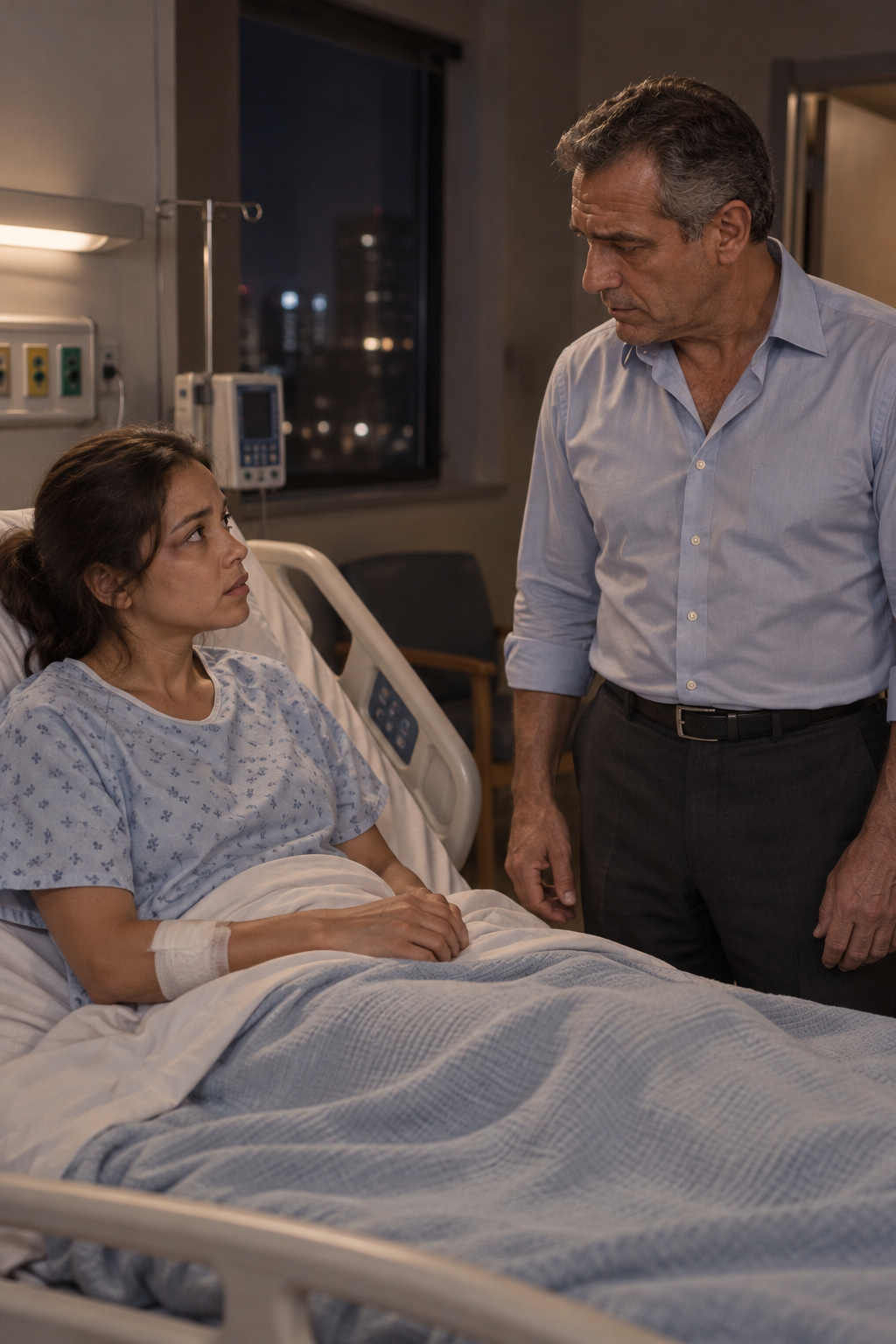
I woke a little after midnight in a hospital bed with two cracked ribs, a concussion, and ten stitches in my forearm. A nurse named Denise told me my daughter was safe and asleep in the hallway. She added, with the careful tone people use for things they find strange, that Mr. Valenti had refused a private waiting room and had been sitting in a plastic chair next to my child for hours.
I told Denise to send him in. I want to be clear about why, because later people would assume gratitude. It wasn't gratitude. Men who worked for him had put me on that floor, or so I'd been told, and I wanted to look at him with my own eyes while I still had the strength to be afraid of him properly.
He came in without a jacket. Lucy had it, I learned, folded under her head. He was older than the photographs and more tired, and he stood at the foot of the bed as if he had not decided whether he was allowed to sit. “She's safe,” he said, before I could ask. “She's outside.”
“She shouldn't be near you.”
“At least we're being honest.”
“Did you send them?”
“No.”
“Would you tell me if you had?”
“No,” he said. “But I'd have no reason to be sitting here.” I told him that was not an answer, that was a man with an alibi, and something moved at the corner of his mouth that was almost a smile. I watched his hands. They were steady. His eyes kept going to the doorway where my daughter slept. That did not make me trust him. It made me pay attention.
I told him about Mateo, because there was no way to explain the night without it. My brother gambles, and he is not a bad person, and I have stopped believing those are always different things only on the nights I'm too tired to argue. Six months earlier he had taken a maintenance job at Harbor Row Storage on the river. He found a sealed room behind a false wall, with boxes of ledgers and photographs, and he took a metal case out of it. Six weeks ago he came to my door frightened, said men were watching him, and gave me a small brass key. If anything happened to him, I was never to give it to anyone named Costa or Ferrante.
The second name changed Nick's face. “Gino Ferrante,” he said. He told me Ferrante had been his closest friend once, and had been reported dead for twenty-eight years. Then he told me that Ferrante had called his phone that night, from a number he did not recognize, and had said that what was in those boxes had something to do with a woman named Carla.
“Mateo mentioned a Carla,” I said. “He didn't say why.” Nick looked at the dark window and said she was someone he had known. I waited. He gave me nothing more, and I understood that I had just watched a man guard a grave.
He told me what Joey's people had found in the first hours: Costa's car abandoned near the river, and word that Costa had not been collecting a gambling debt at all. He had been collecting papers. “Mr. Valenti,” I said, “you're judging my choices from a very expensive suit,” because he had asked why I'd trusted a brother who disappeared over men who threatened my daughter. I expected him to stand up. He said, slowly, that nobody talked to him that way. “Good,” I said. Then I told him the truth, which was that I was scared, and that my daughter had run through the streets for help because I could not protect her.
“Why did you come?” I asked him. “I don't know,” he said, and then, because I didn't believe him, “Neither do I.” When he stood to go I stopped him. If he was here because of Carla, I said, then we wanted the same thing, and it was the truth. For thirty years, he told me later, he had believed the truth was only another weapon. That night he looked at me like a man who had been handed a door.
I lay there thinking it through, slowly, because of the concussion. Lucy had turned seven on August 15. A brass key in a plastic heart on my seven-year-old's neck was the most dangerous object in that building. Costa would come back. If someone was going to be asked for that key again, it should not be my child. I told him where it was. Then I told him my one condition: he would not take it off her neck. He would ask her, and she would decide.
He agreed without arguing, which surprised me. He said a man named Pete Genaro, one of his own, would sit outside my door, and that Pete had sat outside worse rooms. Denise said she would keep an eye on the hall.
Lucy came back to me at a quarter past one with the pink heart open and empty in her fist. She'd been awake, she told me, when Mr. Valenti knelt down, and he hadn't touched her necklace. He'd said her mama had asked him to ask, and that she could say no. She had said yes. “He said thank you,” she told me. “Like I was a grown-up.” She fell asleep against my good side within minutes, and the light from under the door showed Pete Genaro's shoes.
I lay awake with my arm around her. I had just handed the only thing my brother had trusted me with to the most feared man in Cleveland, and the only evidence I had that he wasn't lying to me was that he'd asked my daughter's permission. It was not much to weigh against a lifetime of being careful. It was the first thing all night that had weighed anything at all.